Your "free" trade may have been paid for by someone else.
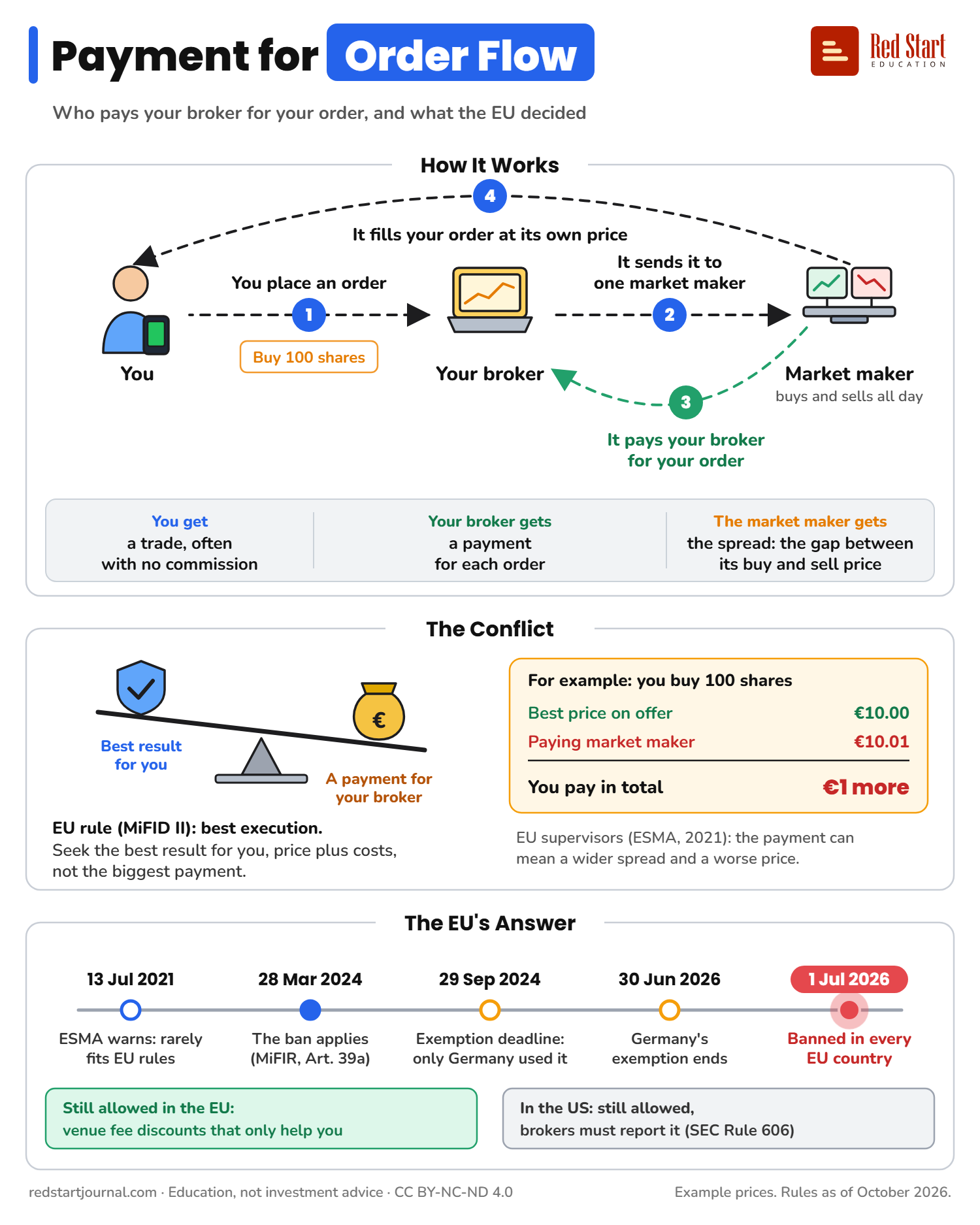
With payment for order flow, a market maker pays your broker to fill your orders.
The risk: the broker picks the payer, not the best price.
The EU banned it in 2024. Germany kept it for its own clients until 30 June 2026.
Since 1 July 2026 it is banned in every EU country.
Did you know your orders had a price?
Education, not investment advice.
Read the sheet as text
Payment for Order Flow.
Who pays your broker for your order, and what the EU decided.
How It Works.
- You place an order. Buy 100 shares. You, to your broker.
- It sends it to one market maker. A market maker buys and sells all day.
- It pays your broker for your order.
- It fills your order at its own price.
You get a trade, often with no commission.
Your broker gets a payment for each order.
The market maker gets the spread: the gap between its buy and sell price.
The Conflict.
Best result for you, against a payment for your broker.
EU rule (MiFID II): best execution. Seek the best result for you, price plus costs, not the biggest payment.
For example: you buy 100 shares. Best price on offer: €10.00. Paying market maker: €10.01. You pay in total €1 more.
EU supervisors (ESMA, 2021): the payment can mean a wider spread and a worse price.
The EU's Answer.
13 Jul 2021: ESMA warns: rarely fits EU rules.
28 Mar 2024: the ban applies (MiFIR, Art. 39a).
29 Sep 2024: exemption deadline: only Germany used it.
30 Jun 2026: Germany's exemption ends.
1 Jul 2026: banned in every EU country.
Still allowed in the EU: venue fee discounts that only help you.
In the US: still allowed, brokers must report it (SEC Rule 606).
Example prices. Rules as of October 2026.
redstartjournal.com · Education, not investment advice · CC BY-NC-ND 4.0