Some funds charge you before your money is even invested.
Put in €10,000 with a 3% entry charge: only €9,700 is invested.
Leave with a 1% exit charge: €100 more stays behind.
Both come on top of the yearly ongoing charge.
The fund's KID shows them as the most you can pay. You may pay less.
Have you checked the "Composition of costs" table in your fund's KID?
Education, not investment advice.
Read the sheet as text
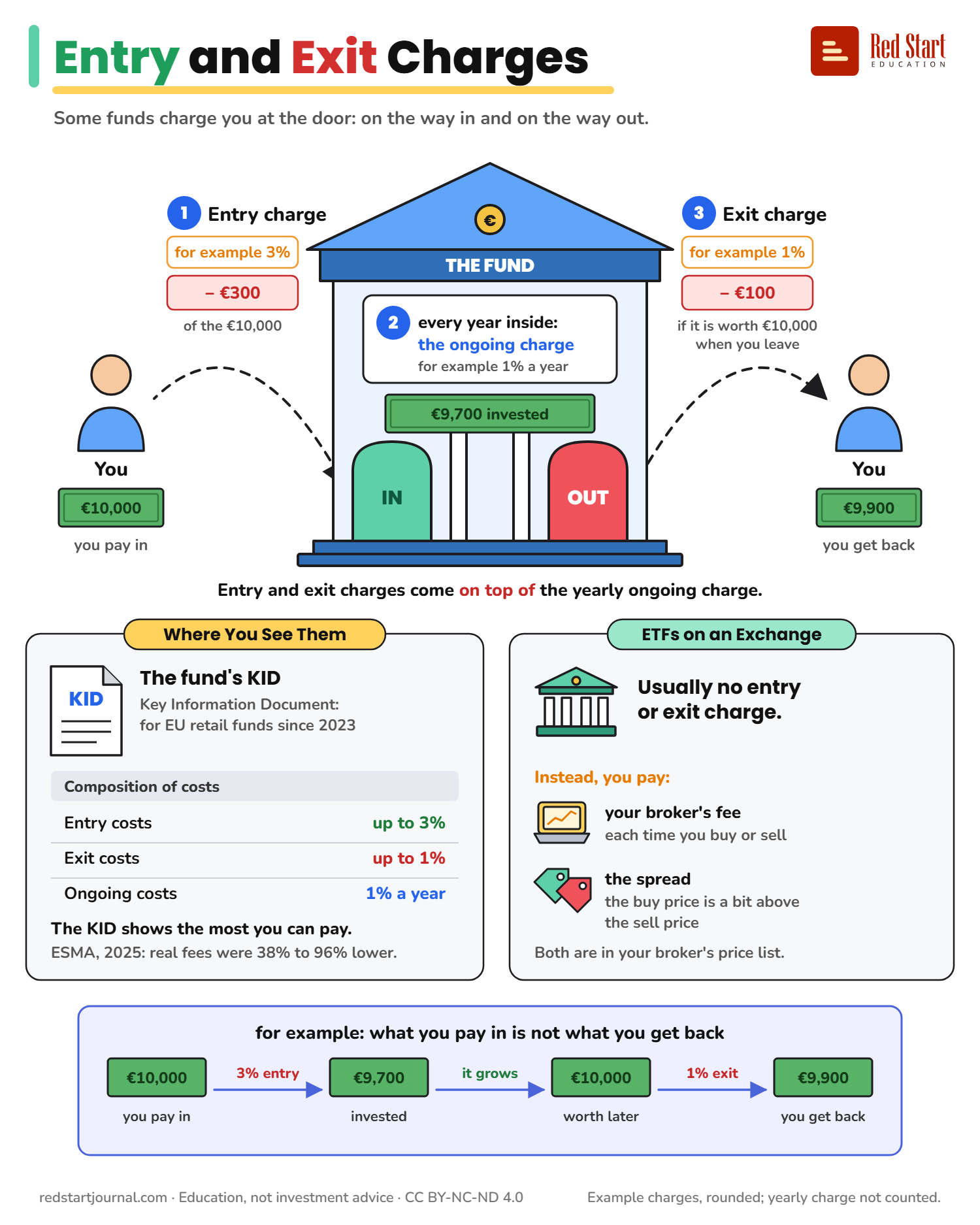
Entry and Exit Charges. Some funds charge you at the door: on the way in and on the way out.
You pay in €10,000.
- Entry charge, for example 3%: minus €300 of the €10,000. €9,700 is invested in the fund.
- Every year inside: the ongoing charge, for example 1% a year.
- Exit charge, for example 1%: minus €100, if it is worth €10,000 when you leave. You get back €9,900.
Entry and exit charges come on top of the yearly ongoing charge.
Where You See Them. The fund's KID: Key Information Document, for EU retail funds since 2023. Composition of costs: entry costs up to 3%, exit costs up to 1%, ongoing costs 1% a year. The KID shows the most you can pay. ESMA, 2025: real fees were 38% to 96% lower.
ETFs on an Exchange. Usually no entry or exit charge. Instead, you pay: your broker's fee, each time you buy or sell; and the spread: the buy price is a bit above the sell price. Both are in your broker's price list.
For example: what you pay in is not what you get back. €10,000 you pay in, 3% entry, €9,700 invested, it grows, €10,000 worth later, 1% exit, €9,900 you get back.
Example charges, rounded; yearly charge not counted. redstartjournal.com · Education, not investment advice · CC BY-NC-ND 4.0