Your cost is not one number. It is a sum.
The fund's yearly charge. The fund's own trading. Your broker's commission.
Currency exchange, the spread, custody, and in some countries a tax on buying shares.
In the EU, your bank or broker must add them up for you, in euros and in %.
Before you invest, and every year after.
Have you read your last yearly cost statement?
Education, not investment advice.
Read the sheet as text
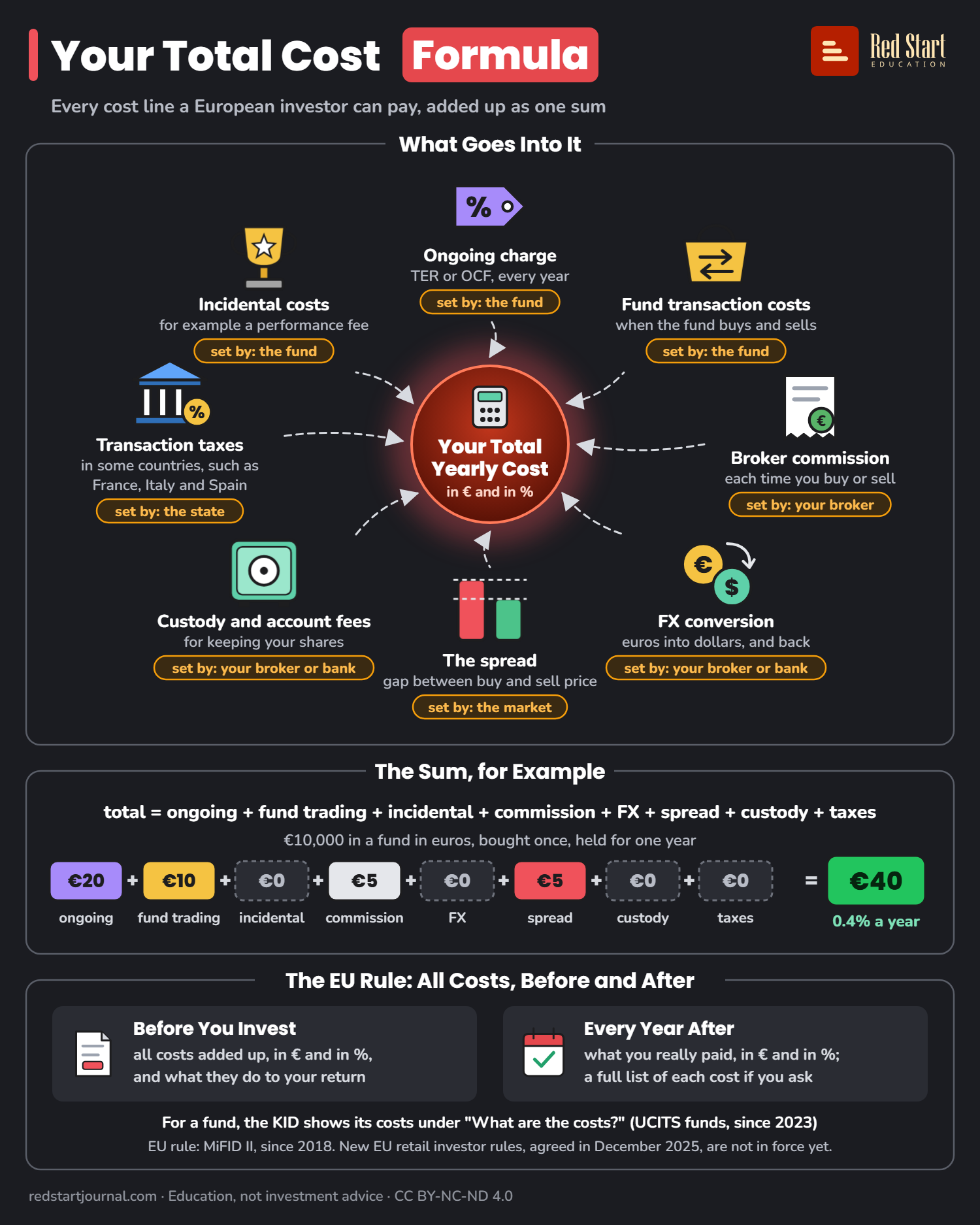
Your Total Cost Formula. Every cost line a European investor can pay, added up as one sum.
What Goes Into It. In the centre: your total yearly cost, in € and in %.
- Ongoing charge: TER or OCF, every year. Set by: the fund.
- Fund transaction costs: when the fund buys and sells. Set by: the fund.
- Broker commission: each time you buy or sell. Set by: your broker.
- FX conversion: euros into dollars, and back. Set by: your broker or bank.
- The spread: gap between buy and sell price. Set by: the market.
- Custody and account fees: for keeping your shares. Set by: your broker or bank.
- Transaction taxes: in some countries, such as France, Italy and Spain. Set by: the state.
- Incidental costs: for example a performance fee. Set by: the fund.
The Sum, for Example. Total = ongoing + fund trading + incidental + commission + FX + spread + custody + taxes.
€10,000 in a fund in euros, bought once, held for one year: €20 ongoing + €10 fund trading + €0 incidental + €5 commission + €0 FX + €5 spread + €0 custody + €0 taxes = €40, that is 0.4% a year.
The EU Rule: All Costs, Before and After.
Before You Invest: all costs added up, in € and in %, and what they do to your return.
Every Year After: what you really paid, in € and in %; a full list of each cost if you ask.
For a fund, the KID shows its costs under "What are the costs?" (UCITS funds, since 2023).
EU rule: MiFID II, since 2018. New EU retail investor rules, agreed in December 2025, are not in force yet.
redstartjournal.com · Education, not investment advice · CC BY-NC-ND 4.0