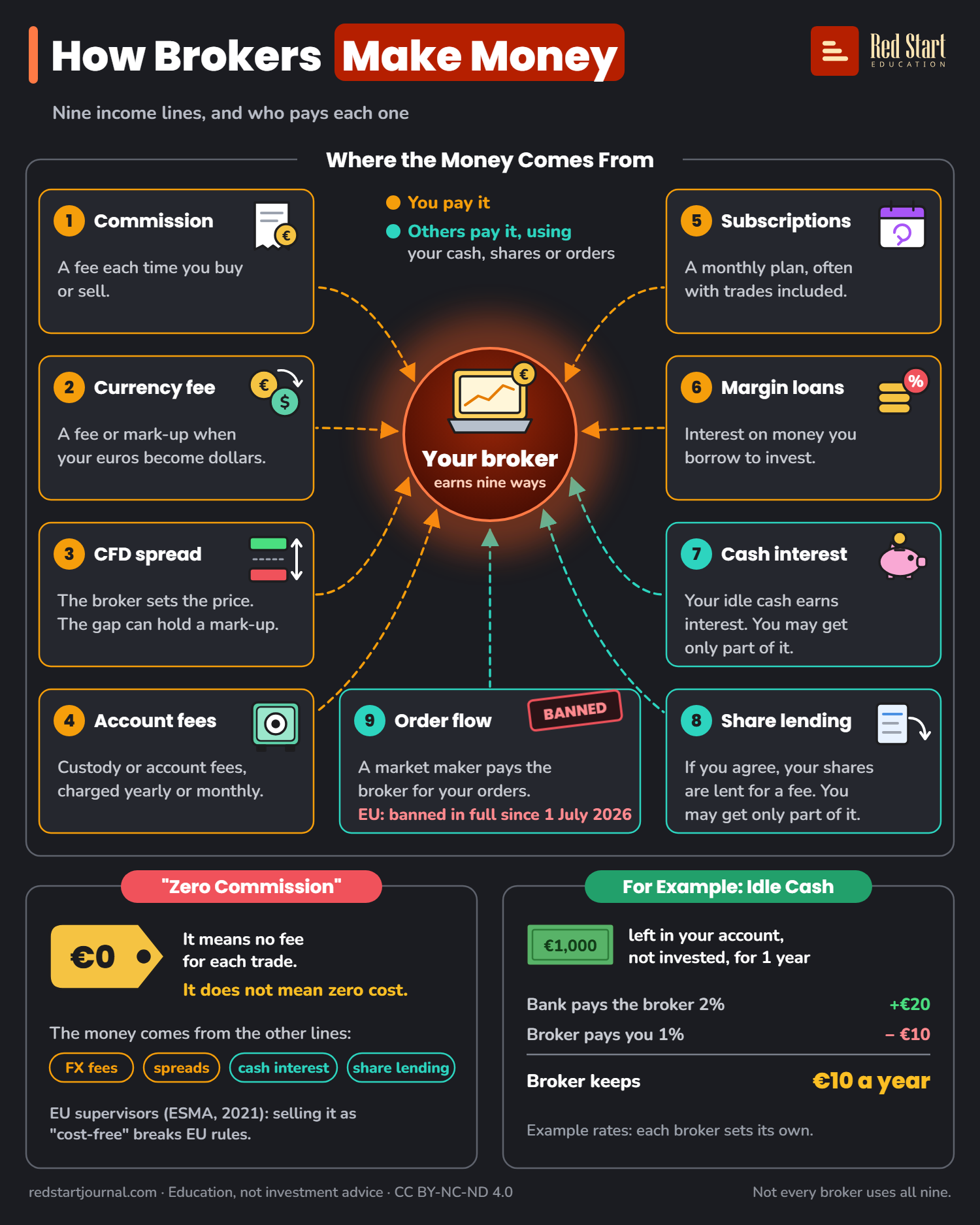
"Zero commission" does not mean your broker works for free.
It earns in nine ways. You pay six of them: commissions, currency fees, spreads, account fees, plans and loan interest.
Others pay the other three, using your cash, your shares or your orders.
One of them, payment for order flow, has been banned in every EU country since 1 July 2026.
Which of the nine can you find in your broker's fee list?
Education, not investment advice.
Read the sheet as text
How Brokers Make Money.
Nine income lines, and who pays each one.
Where the Money Comes From.
You pay it. Others pay it, using your cash, shares or orders.
Your broker earns nine ways.
- Commission: a fee each time you buy or sell.
- Currency fee: a fee or mark-up when your euros become dollars.
- CFD spread: the broker sets the price. The gap can hold a mark-up.
- Account fees: custody or account fees, charged yearly or monthly.
- Subscriptions: a monthly plan, often with trades included.
- Margin loans: interest on money you borrow to invest.
- Cash interest: your idle cash earns interest. You may get only part of it.
- Share lending: if you agree, your shares are lent for a fee. You may get only part of it.
- Order flow: a market maker pays the broker for your orders. EU: banned in full since 1 July 2026. Banned.
"Zero Commission".
€0. It means no fee for each trade. It does not mean zero cost.
The money comes from the other lines: FX fees, spreads, cash interest, share lending.
EU supervisors (ESMA, 2021): selling it as "cost-free" breaks EU rules.
For Example: Idle Cash.
€1,000 left in your account, not invested, for 1 year.
Bank pays the broker 2%: +€20.
Broker pays you 1%: minus €10.
Broker keeps €10 a year.
Example rates: each broker sets its own.
Not every broker uses all nine.
redstartjournal.com · Education, not investment advice · CC BY-NC-ND 4.0